Make a donation to the Museum
Tokyo Japan
 **The Space That Once Existed: An Artist's Reckoning, Twenty-Five Years After September 11**
For all those who did not survive September 11, 2001 — twenty-five years on, still mourned.
I was in my studio in Paris on the afternoon of September 11, 2001, drinking tea, when the phone rang. It was a friend who worked at the American Embassy. "Hiroshi, turn on the television," he said. "There's been a massive terrorist attack in New York. Don't go outside today." I remember fumbling for the remote, and then the image that filled the screen — a sight I had never witnessed before, and have not stopped thinking about since.
Twenty-five years later, I am still trying to understand what I saw that afternoon, an ocean away from where it happened. That distance is, I think, part of the story. I was not in New York. I did not lose anyone I knew. What I experienced was the event as an image — mediated, framed, already historical the moment it reached my screen. And it was from that position, as a witness at one remove, that I began to make the work that eventually became "MAD DOG TRAINING MADE EASY."
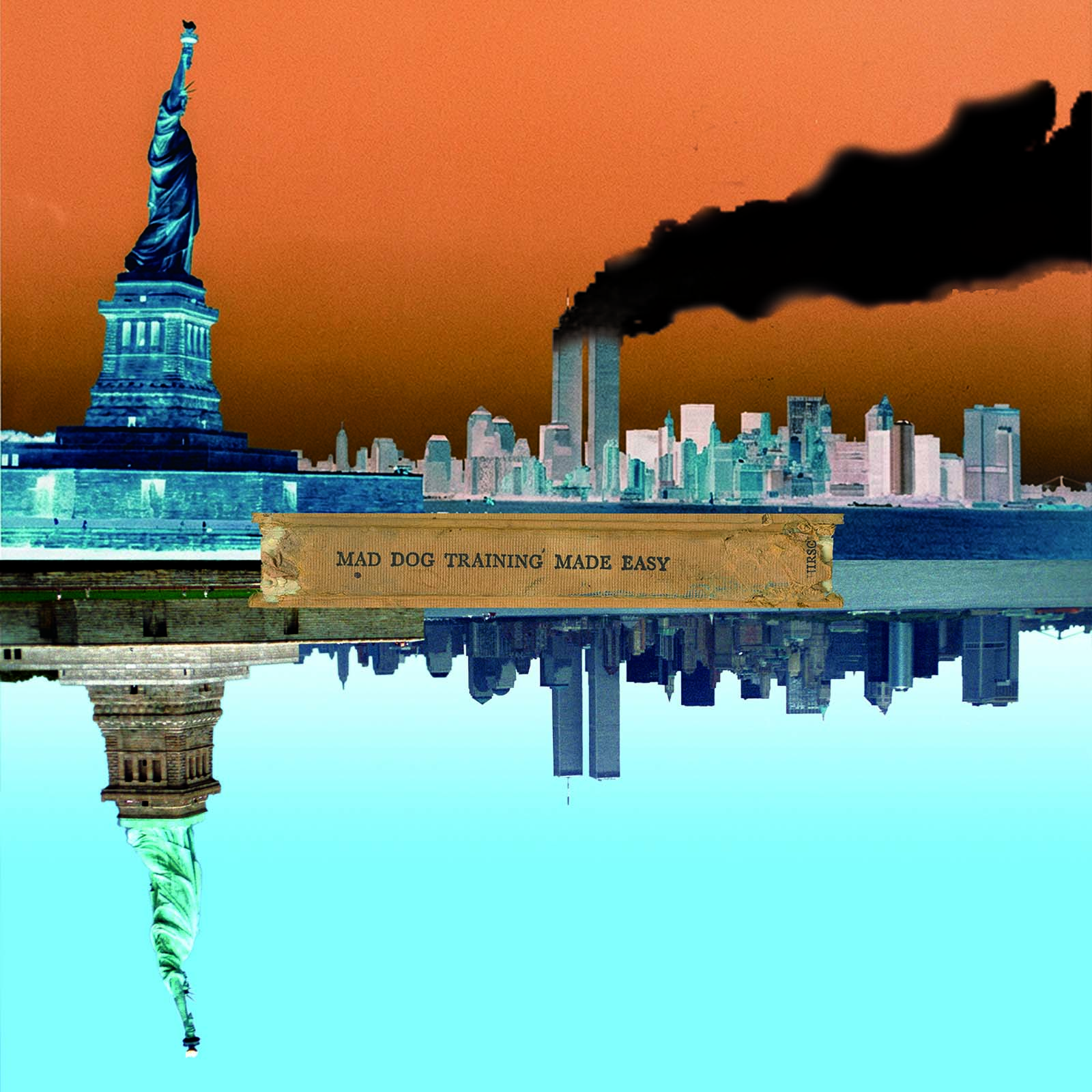
I have been an artist working across sculpture and, more recently, augmented reality, but this piece began, and remains, a photomontage — two skylines of New York fused into a single frame. The upper half is a negative: the Statue of Liberty and the World Trade Center standing beneath a column of black smoke, the space as it existed on that specific date, transfigured by the event. Mirrored below it, in blue, is a positive: the same skyline as it once existed, peaceful, before it was lost. I have spent much of my career preoccupied with the gap between a space that exists and a space that once existed — what a place carries after its physical form has changed or vanished entirely. September 11 gave that preoccupation its most brutal example.
The title is not a reference to American foreign policy, nor to the "War on Terror" that followed. It is a critique of something narrower and, I think, more disturbing: the machinery by which a human being is turned into an instrument of mass killing. Calling someone a "mad dog" is old rhetorical shorthand for an enemy beyond reason — but the phrase also describes, uncomfortably well, what indoctrination does to a person: it trains, methodically and with apparent ease, the capacity for atrocity. That transformation — the making of the weapon out of the person — is what the title interrogates.
I did not make this work in the days after the attacks. I made it a year later, once the initial shock had receded enough that I could look at the image without flinching, and could ask what, exactly, I wanted to preserve of that afternoon. That is, I think, one of the quieter functions art performs that news coverage cannot: a news image is built to be consumed once and replaced by the next one. An artwork is built to be returned to. I wanted an image that a viewer could sit with — in 2002, and now, twenty-five years later, on the day itself.
I am aware that posting a photomontage of the towers, on the anniversary, from an artist based in Tokyo who was in Paris that day, invites a fair question: what claim do I have to this image? I do not think distance disqualifies a response to atrocity — grief and alarm were not confined to Manhattan that week — but it does, I think, obligate a certain humility. I offer this work as a dedication, not a diagnosis. It belongs to everyone who lost someone that day, first, and to the rest of us, who lost something harder to name, second.
Twenty-five years on, I find I no longer know how to end this piece with confidence. I once believed the mirrored, peaceful half of the image — the "positive" beneath the "negative" — represented something recoverable, a world order that had merely been inverted and could, in time, be set right again. I am less sure of that now. So I will end instead with the question the work itself asks, unresolved, of anyone willing to sit with it a while longer: will the day ever come when that submerged, peaceful order returns to our hands?
*Hiroshi Chitose is an artist and the representative director of Interscale Inc., based in Tokyo.
Hiroshi Chitose is an artist based in Tokyo,JAPAN Working across sculpture, landscape design, and augmented reality (AR/WebAR). He studied under the sculptor late Dani Karavan from 1995 to 2002. He is the representative director of Interscale Inc., a design and architecture firm he founded in 1993. Originally trained in fine art and fashion design, he later shifted toward architecture and landscape design before beginning to make sculpture in 2021. His practice is centered on the difference between "the space that exists" and "the space that once existed."
2023: Exhibited the augmented reality sculpture "I Dance in the Fountain" at the Kurokawa Satoyama Art Project Outdoor Art Exhibition.
2024: exhibited the augmented reality sculpture "I Dance on the Ground" at the Kurokawa Satoyama Art Project Outdoor Art Exhibition. Began creative work using generative AI.
2025: exhibited the augmented reality sculpture "The Origin of Life" at the Kurokawa Satoyama Art Project Outdoor Art Exhibition.
Successfully implemented generative AI into CAD software.
Member of the Architectural Institute of Japan
Member of the Tachikawa Cultural and Artistic Town Development Council