Scholar Explains Why Women Are Joining ISIS

Scholar Explains Why Women Are Joining ISIS

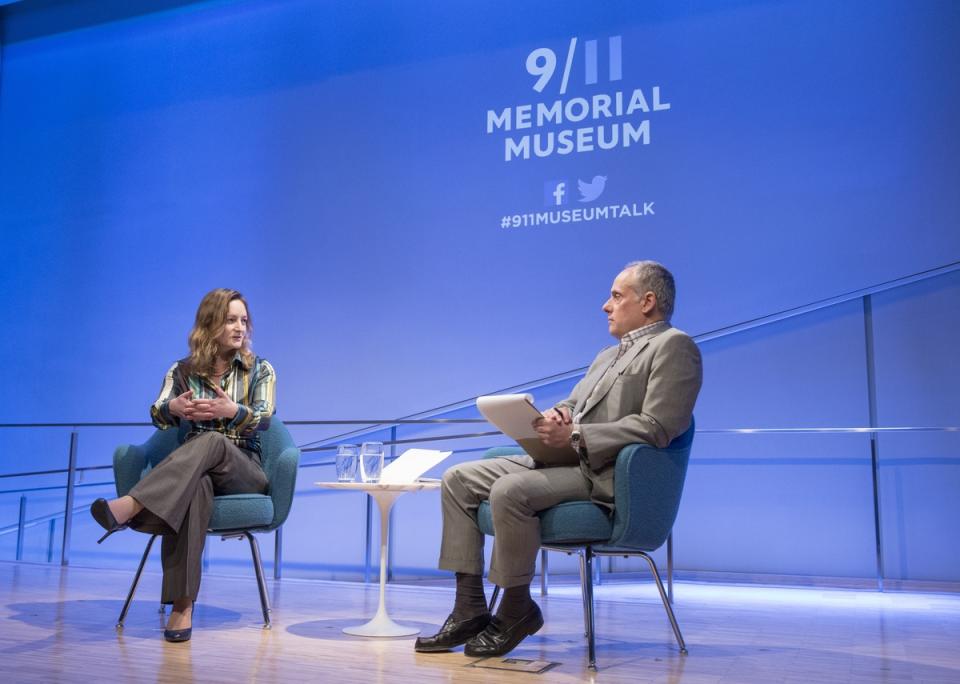
Katherine E. Brown speaks onstage at the Museum Auditorium with Clifford Chanin, the executive vice president and deputy director for museum programs.
Katherine E. Brown, an associate professor of Islamic studies at Birmingham University speaks at the 9/11 Memorial Museum with Cliff Chanin. Photo by Jin Lee.

On Wednesday evening, the 9/11 Memorial Museum hosted Katherine E. Brown, a scholar who specializes in gender and terrorism, to discuss ISIS’ recruitment of women. Brown believes that the terrorist organization targets women who feel isolated in their communities.

"ISIS is very good at presenting the idea that they’re your friend. They have recruiters who work online constantly," Brown said.

Brown explained that ISIS’ social messaging strategy is to present vulnerable women with the exciting prospect of adventure: traveling to a different country, choosing a jihadi soldier to marry, and joining their pious community in the name of God. She gave an example of a young woman from London who joined ISIS because she felt alienated and wanted to return to the ancient, sacred time of the prophet Muhammad.

ISIS’ aggressive outreach tactics have been successful, but what can be done to prevent young adults from joining their ranks? Brown suggested that teaching students debating skills would effectively debunk radical thinking.

"[Debating] gives young people the confidence to speak, the confidence to take apart arguments. It gives them the ability to challenge people like me, you, as well as the Islamic State, and that can only be a good thing," she said.

Watch a video of Brown discussing the destruction of Palmyra and other religious shrines in Syria, and its impact on women.
Please enable Javascript to watch this video

Learn more and reserve tickets for upcoming programs. Admission is free, but tickets must be reserved in advance.

By Liz Bistrow, Communications and Marketing Coordinator

Tribeca Film Festival Reaches 15-Year Milestone

Tribeca Film Festival Reaches 15-Year Milestone

A yellow taxi cab passes the entrance to the Tribeca Film Festival. A crowd of people is under an illuminated red sign that reads “Tribeca Film Festival.”

The 15th annual Tribeca Film Festival kicked off last night and will run through April 24. The festival features 77 world premiere films and a special 40th anniversary screening of the iconic "Taxi Driver."

The festival was founded in 2002 by Jane Rosenthal and Robert De Niro, both 9/11 Memorial board members, and Craig Hatkoff in response to the devastating Sept. 11 attacks to revitalize the lower Manhattan community and New York City.

"When 9/11 happened, obviously, we thought well this would be a way to revive the neighborhood," De Niro said. "It was successful."

"I can’t say enough about what the Tribeca Film Festival has meant for the rebirth of what was potentially most at risk following 9/11: our spirit," recalled 9/11 Memorial President Joe Daniels. "Jane, Bob and Craig are in the midst of leaving a tremendously strong legacy based on the power of coming together that we saw in the aftermath of that terrible day."

The founders didn’t plan on making it a yearly endeavor, but the festival continues to attract crowds and talent from all over. It has become known as one of the most creatively directed film festivals in the world. This year, the festival received 6,626 submissions. A total of 101 films were selected.  Learn more here.

Hear more about the festival’s journey in De Niro’s podcast from the "Our City. Our Story." series.

By Hannah Coffman, Digital Content Manager

Woman Running Cross-Country to Honor 9/11 Victims

Woman Running Cross-Country to Honor 9/11 Victims

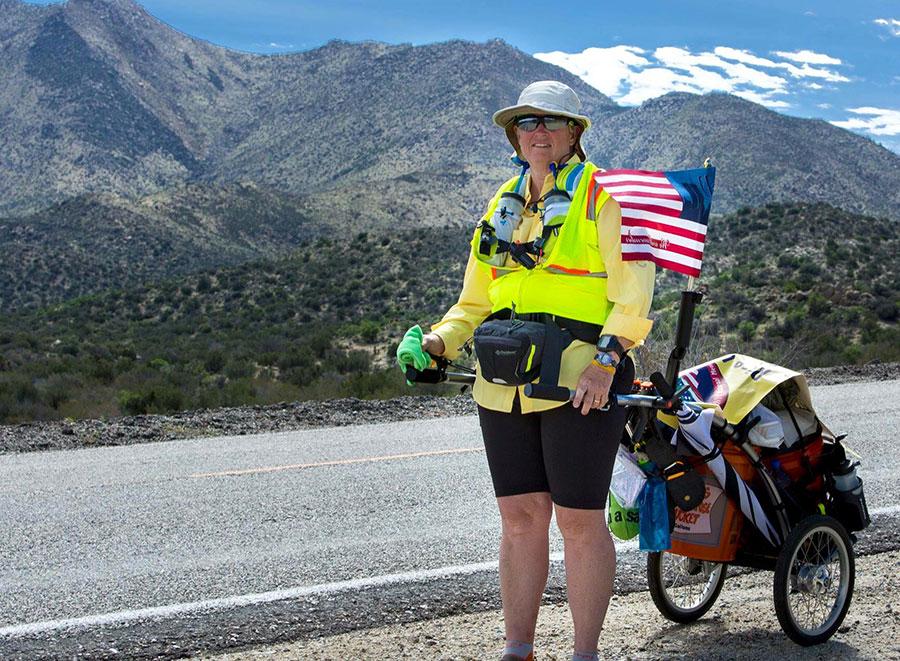
Jan Walker poses for a photo in front of a mountain range during her four-month journey across the U.S. She is standing beside a road as she wheels her belongings in a cart behind her.
Jan Walker during her four-month journey across the US. Photo courtesy of Jan Walker from the Rise Up for the Fallen Facebook page.

A woman from Knoxville, Tenn., is running across the United States on a four-month journey in honor of the victims of the Sept. 11 attacks.

Jan Walker began her journey in California in March and she plans to reach the National 9/11 Pentagon Memorial by this summer. Her goal is to raise awareness to establish the September 11th National Memorial Trail, an 1,100-mile route planned to stretch between the three crash sites, the 9/11 Memorial in New York, the Flight 93 National Memorial in Shanksville, Pa., and the National 9/11 Pentagon Memorial in Arlington, Va. 

"The tragedies of that day affected everyone," Walker told KTAR News. "As an American, I believe that it touches everyone."

Walker regularly posts about her journey on the Rise Up for the Fallen Facebook page.

By 9/11 Memorial Staff

Our City. Our Story. Podcast Series: Major League Pitcher

Our City. Our Story. Podcast Series: Major League Pitcher

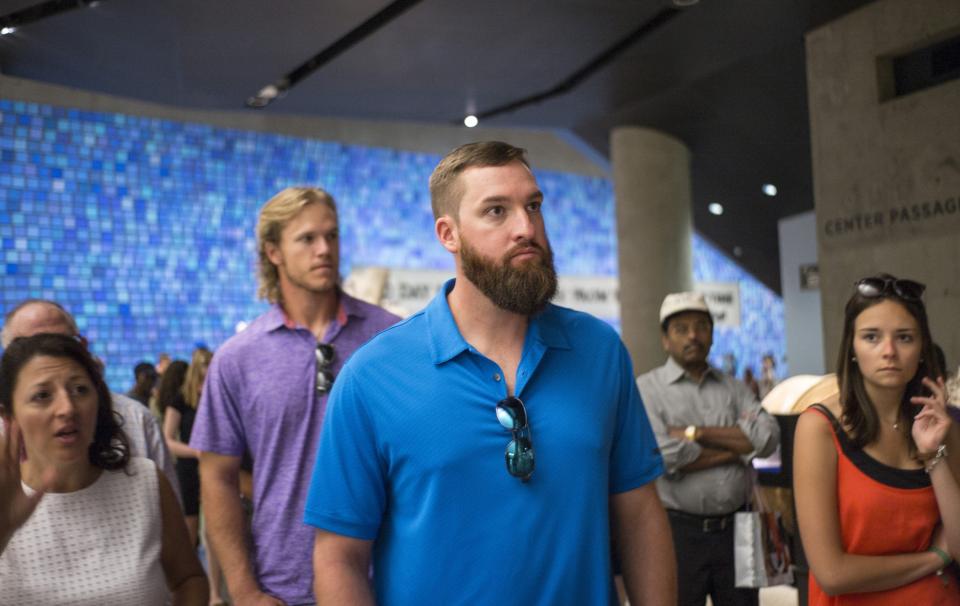
Bobby Parnell, the former Mets pitcher, visits the 9/11 Memorial Museum. Other visitors stand behind him.
Former pitcher for the New York Mets, Bobby Parnell, visits the 9/11 Memorial Museum. Photo by Jin Lee.

The New York Mets return to Citi Field tonight to face the Philadelphia Phillies for their home opener. Missing from this year’s line-up is pitcher Bobby Parnell, who joined the Detroit Tigers earlier this year.

In the eight seasons that Parnell pitched for the New York Mets, he became an adopted New Yorker. Despite being in his home state of South Carolina on Sept. 11, the attacks felt personal to Parnell who is from a family of firefighters.

In an interview for the Our City. Our Story. podcast series, Parnell speaks about his connection to the first responder community, what he loves about New York City, and the link between baseball and Sept. 11.

Listen to his story.

By 9/11 Memorial Staff

9/11 Museum Honors Legacy of New York Yankees

9/11 Museum Honors Legacy of New York Yankees

A rain-check Yankees ticket from September 10, 2001, is displayed. The ticket notes that the game will take place on Tuesday, September 11, 2001 at 7:05 p.m.
Rain Check Yankees Tickets from cancelled Sept. 10, 2001 game. Gift of Misty Blount-Chappelle in honor of Carnell E. Chappelle, Alison Yerkey Faith, and David Clayton Faith (US military).

With the Bronx Bombers opening their season yesterday at Yankee Stadium, the 9/11 Memorial and Museum honors the connection between the Yankees and legacy of Sept. 11.

Among the first artifacts on view in the museum’s historic exhibition is a pair of Yankees tickets from Sept. 10, 2001. That night, Yankee Roger Clemons readied to pitch his 6th 20-win season against his former team, the Boston Red Sox. More than 50,000 fans flocked to the original Yankee Stadium in anticipation of the big game. When rain forced a cancellation, the fans were left to find other forms of entertainment.

Many instead turned to “Monday Night Football” to watch the Giants play in Denver. The game went late, past midnight on the East Coast. Workers who usually would have been at their desks the time hijacked flight 11 knifed into the North Tower at 8:46 a.m. were running late. In oral histories recorded for the museum, some survivors credited the decision to watch the football game after the Yankee’s game was rained out for saving their lives that day.Mickey Mantle baseball card donated in memory of Vincent Litto.

These Yankee tickets became a symbol of fate and represent the ways in which small decisions had significant consequences.

The team’s connection to 9/11 also extends to the museum’s memorial exhibition. Inside, lost Yankees fans are remembered through photographs of beaming faces in the stands, artifacts such as baseball caps and jerseys, and recordings of personal recollections from loved ones about their shared affinity for the team.   

One fan who died in the attacks, Brooklyn-born Vincent Litto was at work on the 104th floor of the North Tower. Listen to his best friend and neighbor Rocky R. tell a story about their shared love of their baseball club and how it defined their friendship.

By Jenny Pachucki, 9/11 Memorial Content Strategist  

Running Toward the Fire: A First Responder’s Account

Running Toward the Fire: A First Responder’s Account

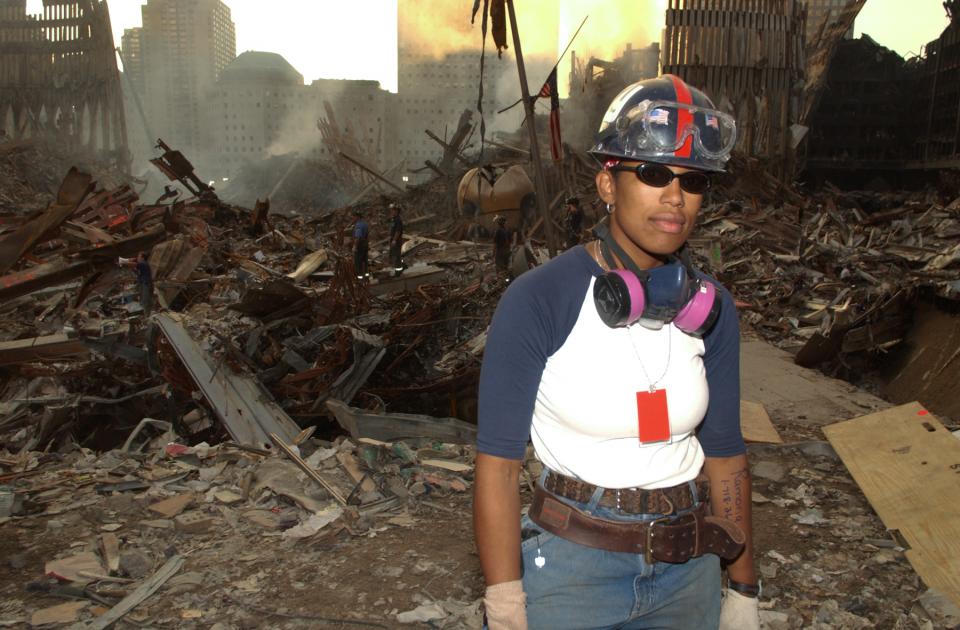
Ramona Diaz-Allegrini poses for a photo in front of a smoky pile of debris at Ground Zero. The Koenig Sphere and the steel facades of the Twin Towers are visible in the background.
Ramona Diaz-Allegrini at ground zero. Photo by Andrea Booher.

Ramona Diaz-Allegrini, a New York City union carpenter, was one of the few female first responders who aided in the rescue and recovery effort at ground zero.

Before the attacks on that tragic morning, Diaz-Allegrini was working on the construction of an Upper East Side high-rise building. Perched on top of a crane, she watched in horror as two planes crashed into the World Trade Center. In that terrifying moment, Diaz-Allegrini’s only thought was to make sure her 4-year-old daughter was safe. She raced home to Coney Island where her daughter was waiting for her, but their reunion was cut short by a loud voice ringing out from her work radio.

“Where are you? We need you to come down.” It was Diaz-Allegrini’s employer, asking her to join him at ground zero. Her heart sank. How can one person run toward a fire, when everyone else is running away? She was afraid to answer the call, to face the devastation of her city, but felt an overwhelming urge to help. With her knowledge of construction and ironwork, she knew she could help.

“I had to do the right thing,” Diaz-Allegrini said, recalling her decision. “I had to put on my big girl jacket. I kissed my daughter, got in my car, and drove.”

When she arrived at ground zero, the site was in chaos. She was immediately asked to join a bucket brigade to remove debris from the wreckage formed by the collapse of the World Trade Center buildings. For two weeks, she worked nearly 24 hours a day in the humid pile, burning, cutting, and transporting rubble.

During the spare hours Diaz-Allegrini was able to rest, she found refuge at St. Paul’s Chapel. Volunteers soon arrived at the site with supplies, food, and fresh clothing. She was inspired by the dedication of the workers and volunteers and became a leader on her own team. She would strategize and instruct workers, including her boss, on the best methods to clean up the site. “I felt like I could take charge,” Diaz-Allegrini said.

Diaz-Allegrini always possessed the skills and intelligence of a capable carpenter, but in the midst of the extreme emotional and physical challenges of working at ground zero, she truly found her strength and her voice. She earned the respect of her team. She knew she was meant to work in carpentry and that she would remember the lessons she learned from ground zero for the rest of her life.

By 9/11 Memorial Staff
Subscribe to