Is it free to visit the 9/11 Memorial?
Yes.
Find answers to frequently asked questions about the 9/11 Memorial & Museum and the events of September 11, 2001.
For tickets to the Museum, please click here.
No, 9/11 families do not pay admission to access the Museum. For more information about how to plan your visit to the Museum, please click here.
The public may visit free of charge on Monday evenings from 5:30-7 p.m. Free Admission Monday tickets are available on the website each Monday beginning at 7 a.m. ET and are first come, first serve.
On the first Sunday of each month, admission is free to those who work, live, and study in the New York area. Learn more about New York First Sundays.
The 9/11 Memorial is located at the site of the former World Trade Center complex in lower Manhattan, and occupies approximately half of the 16-acre site. The 9/11 Memorial features two enormous waterfalls and reflecting pools, each about an acre in size, set within the footprints of the Twin Towers.
Visitors can inquire about lost items by emailing lostfound@911memorial.org.
The 9/11 Memorial is open daily from 8 a.m. to 8 p.m. Please click here for more information on how to plan your visit.
The names of the nearly 3,000 victims of the September 11, 2001 and February 26, 1993 terrorist attacks are inscribed on bronze panels lining the two Memorial pools. Waterfalls cascade down all four sides of each pool, creating a special place for remembrance and reflection. The surrounding plaza is filled with swamp white oak trees and a Callery pear known as the Survivor Tree, which was nursed back to health after surviving the 9/11 attacks.
The entrance to the 9/11 Memorial Museum houses two enormous tridents within its glass Atrium Terrace. The tridents are artifacts from the steel facade of the original 1 WTC, also known as the North Tower. Visitors to the Museum will experience the Museum’s core exhibitions, the historical exhibition, and the memorial exhibition. They are located within the archaeological heart of the World Trade Center site. The Museum displays artifacts associated with the events of 9/11, while presenting stories of loss and recovery.
You can find a specific name on the bronze parapet by using the name finder.
The names of each section of the 9/11 Memorial follow the headings below:
AROUND THE NORTH POOL
World Trade Center: Those who were working in or visiting 1 WTC (North Tower) on 9/11
Flight 11: The crew and passengers of American Airlines Flight 11
February 26, 1993: Those who were killed in the bombing of the WTC on February 26, 1993
AROUND THE SOUTH POOL
World Trade Center: Those who were working in or visiting 2 WTC (South Tower) or other areas of the WTC complex on 9/11
Flight 175: The crew and passengers of United Airlines Flight 175
Pentagon: Those who were working in or were visiting the Pentagon on 9/11
Flight 77: The crew and passengers of American Airlines Flight 77
Flight 93: The crew and passengers of United Airlines Flight 93
First Responders: Those who received the 9/11 Heroes Medal of Valor awarded by the White House on September 9, 2005.
Following each heading, the names are arranged so that those belonging to the same affiliation—for example, coworkers of the same company or the crew of each flight—are listed together. The next-of-kin of the victims and surviving colleagues have requested the names of specific individuals next to whom they would like their loved ones’ names inscribed. Some were with relatives, friends, and colleagues; others were with people they barely knew or had just met, but with whom intense bonds were quickly formed as a result of a shared response.
The Memorial and the Museum are located at the World Trade Center site in lower Manhattan at 180 Greenwich Street. Visitors can access the Memorial and Museum by subway, bus, PATH train, ferry, or car. We strongly recommend the use of public transportation to access lower Manhattan.
You can find more information here.
The historical exhibition may not be appropriate for visitors younger than 10 years of age. Adults accompanying younger visitors should exercise discretion before entering.
Arrive 15 minutes before your scheduled start time at the group entrance, located near the southeast corner of the Museum Pavilion. For directions to group check-in and information on bus access, click here.
Bring as little as possible to expedite your entry. All items are screened in x-ray machines and all visitors will be asked to pass through magnetometers. We provide all necessary materials for student programs. Click here for security screening details.
Live captioning and ASL interpretation will be available upon request. For more information, please contact access@911memorial.org.
For lesson plans and helpful resources, visit the Students and Teachers and Resources sections.
During the tour, students explore several exhibitions within the Museum where they encounter artifacts ranging from massive pieces of the original Twin Towers to tributes created in response to the attacks. These exhibits and artifacts help students understand what happened on 9/11 and in its aftermath and consider the ongoing repercussions of the attacks.
No, you can join the program using a web browser by using the meeting ID and password found in the Zoom registration confirmation e-mail you receive after completing the required registration form. More information about joining the tours can be found using the links below.
We have several resources on our website, including online lesson plans, first-person stories, and interactive timelines, which can be helpful in preparing your students for their virtual field trip.
Yes, New York City and New Jersey Schools are eligible for free virtual field trips. For more information, visit our Virtual Field Trips page.
If you need to make any changes to your reservation, please contact Group Sales at groups@911memorial.org.
The 9/11 Anniversary Digital Learning Experience used to be named “Anniversary in the Schools” – it’s the same program, just a different name. The program consists of two parts: a pre-recorded film that can be screened on-demand to accommodate all schedules and time zones; and a live chat with 9/11 Memorial & Museum Education staff.
If you have artifacts, images, or other items of relevance to the history of 9/11 that you believe might interest the Museum’s curators, please complete a collections donation form.
On the form, please describe your proposed donation and provide your preferred contact information. If you are unable to access the form, please call (212) 312-8800 and request that a form be mailed to you. Please include a picture of the item and its measurements with the form. Your completed form may be mailed to the address below or sent via e-mail.
9/11 Memorial Museum
Chief Curator
180 Greenwich Street
New York, NY 10007
collections@911memorial.org
Receipt of your form will be acknowledged within four weeks’ time. Your donation will be evaluated by a curator, who may follow up with any questions. If your proposed donation fits the criteria of the Museum’s collecting policy, it will be recommended for consideration to the Museum’s collections committee. Upon review by the committee, you will be contacted regarding next steps. If you have further questions about this process or wish to check on the status of your form under review, please contact us at collections@911memorial.org.
Donation offers are evaluated by the Museum's collections committee. The committee is composed of professional curators and other staff members knowledgeable in both the scope of the Museum's collection and the conservation issues associated with artifact care, as well as the policies that govern the acquisition process.
The committee’s decision will be guided by the content criteria specified in the institution’s collections management policy and informed by the Museum's current goals for acquisitions. The condition of the item may also be considered in light of the Museum's current resources to properly house and care for it. Clarity and history of ownership, copyright, and similarity to items already in the Museum’s collection may also factor into acquisition decisions.
Typically, the process will take about 8 to 12 weeks from the time your completed form has been received. If your donation offer is submitted for consideration to the collections committee, a member of the collections team may contact you to make arrangements to have the item shipped or dropped off for firsthand inspection. If the item does not require physical inspection and fits the Museum’s collecting criteria, you will hear from a member of the collections team soon after the collections committee review of the donation.
The final step in the donation process involves completing deed of gift paperwork for the donation to document its legal transfer to the Museum. On this form, you will be asked to specify a credit line for the donation which shall accompany the item whenever it is publicly used or displayed. Once the deed of gift has been completed by the donor, it will be cosigned by the Museum's director. Your receipt of this cosigned document indicates that your property has been legally transferred to the Museum in perpetuity.
The Museum does not provide appraisals of the monetary value of your donation. The Internal Revenue Service deems this a conflict of interest, as museums and libraries are “interested parties” and their primary purpose is to acquire and safeguard materials for the public’s educational benefit. Monetary appraisals prepared by such nonprofit institutions are subject to disqualification by the IRS. However, professional appraisers will perform this service for a fee. To find a licensed appraiser in your area, you may wish to contact one of the following organizations for a referral:
American Society of Appraisers
International Society of Appraisers
Appraisers Association of America
The 9/11 Memorial Museum is recognized as a qualified charitable organization. Consequently, the fair market value of your donated materials is generally tax deductible. To take advantage of your deduction, you must file tax form 1040 and, depending on the value or estimated value of your donation, tax form 8283. It is recommended that you consult with your own accountant, attorney, and/or the IRS. You may also consult IRS Publication No. 526, Charitable Contributions, and Publication No. 561, Determining the Value of Donated Property.
The Museum cannot guarantee that any object or image donated to its collection will be exhibited in perpetuity, or temporarily, unless expressly collected for that purpose. Like most museums, only a small fraction of our collection is on view at any given time. Conservation practices also require that certain types of material periodically “rest” from exposure factors such as light, which can diminish or harm the integrity of the object over time. All items accepted into the permanent collection serve as a valuable resource for research and education, and may rotate onto public view from time to time. Uses include display in special and core-history exhibitions, short-term loans to other approved museums and libraries, educational programs, and museum publications, collections catalog, and web features.
The Museum cannot return donated items or records to the donor or his/her heirs once they have been legally accessioned into the permanent collection. By donating your materials to the Museum, you are passing private control of such material to a new owner or educational entity on behalf of the public whose historical understanding will be deepened through access to primary historical evidence.
The Museum may, with approval from the board of directors, remove objects and documents from the collection through a process called deaccessioning. Artifacts or documents that are damaged beyond repair, have a condition that puts other parts of the collection or the staff and public at physical risk, are a duplication of other items in the collection, or are outside the interpretive scope of the collection may be considered for deaccessioning. This practice is a rarity, and will be undertaken only for exceptional reasons. Deaccessioned material may be transferred to another museum or cultural/educational organization, destroyed, or sold. Any proceeds from the sale of deaccessioned material are placed in a restricted acquisition fund to further enrich the quality and scope of the Museum’s permanent collection.
The Museum rarely accepts items on long-term or indefinite loan. While it does accept privately owned material for certain research and short-term display uses, the Museum prefers to commit its storage resources to the preservation of materials in the permanent collection.
Yes. Each member will receive several complimentary one-time guest pass vouchers, depending on the level of membership. These passes will be included in the member package along with the permanent membership card. Please allow 14 business days for passes to arrive. Passes must be in-hand for use at the ticket windows. Members at the "Benefactor" level will also receive several complimentary anytime tickets, which can be used by friends and family without the member being present.
Select items in the Museum’s collection are often featured through the organization’s website and related public communications. Direct access to collection items that are off-view and in storage may be arranged by advance appointment. Please contact the Museum’s collections registrar for further information regarding access at (212) 312-8822. Unprocessed materials, however, may not be available for viewing until they have been fully cataloged. We support scholars working to expand professional and public understanding of a range of topics related to 9/11. Use our scholarly research request form to learn more.
As a courtesy, Museum staff will try to inform you of plans to exhibit, publish, or make educational use of your donated item. In order to do so, you must keep your contact information up to date with the Museum’s collections registrar. Updating your address, e-mail, and/or preferred method of contact information is the most reliable way the Museum can pursue communication with you in the future. Please call the number above or email collections@911memorial.org if your contact information has changed.
Yes. You can upgrade your membership at any time throughout the year. Simply call the Membership Department at (212) 857-0154. If you are renewing your membership and would like to upgrade your membership level, you can do so online, by phone, or by submitting a renewal slip in the mail.
Members at the "Member" level will receive one (1) personalized membership card. Members at all other tiers will receive up to two personalized membership cards if a second name is provided upon purchase. If purchasing at the “Member Premium” level or higher, each cardholder can bring one guest for free every visit without needing to provide a guest-pass voucher.
Reserve your free admission and/or complimentary guest passes to visit the Museum online. Select your membership category and enter your Patron ID, located on the back of your member card or temporary card. For assistance with member reservations, please call the member reservation line at (212) 266-5213.
Member reservations are highly recommended and can be made online or by phone prior to arrival. For public programs, members must make a reservation for themselves and their guests.
Groups of 20 people or more wanting to schedule a visit to the 9/11 Memorial Museum must reserve tickets through the Group Reservations Department. Reservations for groups can be requested via email at groups@911memorial.org.
Please click here for more information.
If for any reason you find that your group is no longer able to visit, please e-mail groups@911memorial.org.
The deadline for requesting adjustments to a group reservation is two weeks before the visit date. Due to high demand, a change in dates, times, or the number of people in your group is subject to availability and is not guaranteed. To request changes, please e-mail groups@911memorial.org.
Yes. Click here for more information about our programs for students.
The Museum offers several different ways to experience its collections and exhibitions. Guided tours are also available for an additional cost.
Please click here for more information.
Please note that no outside tours or lectures are allowed in the Museum.
Outside narration is not permitted in the Museum. Please click here for more information regarding our tour options.
Yes, the Museum Café is located on the Atrium Terrace and, unless otherwise indicated, is open until 7 p.m. Additionally, as a thank you for attending the program, you will receive 10 percent off your café purchase by presenting your program ticket at checkout. However, please note that food and drink are not permitted inside the Auditorium.
ASL interpretation is available, but you must contact the Museum’s at least two weeks prior to the scheduled program to make arrangements. Please contact (646) 583-3419 (voice or VP) or access@911memorial.org to place a request.
The Artists Registry is an online digital database created to provide a gathering place and virtual gallery for visual art, poetry, music, and other mediums by a diverse group of artists created in response to the events of September 11, 2001. Additionally, it is intended to serve as a resource for the artistic community, scholars, journalists, and the interested public. It is not officially curated by the 9/11 Memorial Museum staff.
To participate in the Artists Registry, individuals may self-upload digital files of their creations along with an interpretive statement, biography/resume, contact information, and specifications about media and dimensions of original works. In order to create a profile, you must first establish a 9/11 Memorial website account, if you do not already have one. Once you’ve created an account, you may initiate the process of building your personal Artists Registry profile. You must have access to an active e-mail address, which can also serve as your username, and be prepared to post a minimum of one file to the database.
Only your original songs, readings, or audio recordings of your performed work should be uploaded to your portfolio page. Please make certain that your audio file is in .aif, .aiff, .mov, .qt, .au, .wav, .mp3, .aac, .mpg, .m1v, .m2p, .m2t, .m2ts, .mts, .tod, .mpe, .mpeg, .avi, .dv, .dvi, .f4v, .3gp, .3gpp, .3gp2, or .3gpp format. You should limit your file size to a maximum of 256 MB.
YouTube and Vimeo are two of the most popular video sharing sites on the Internet. Many of the Artists Registry's contributors already have accounts set up and videos posted on these “channels.” To embed a YouTube or Vimeo video directly into your registry page, after logging into your artist control panel, click the tab to “Add Art” in the left navigation. Refer to this screenshot: 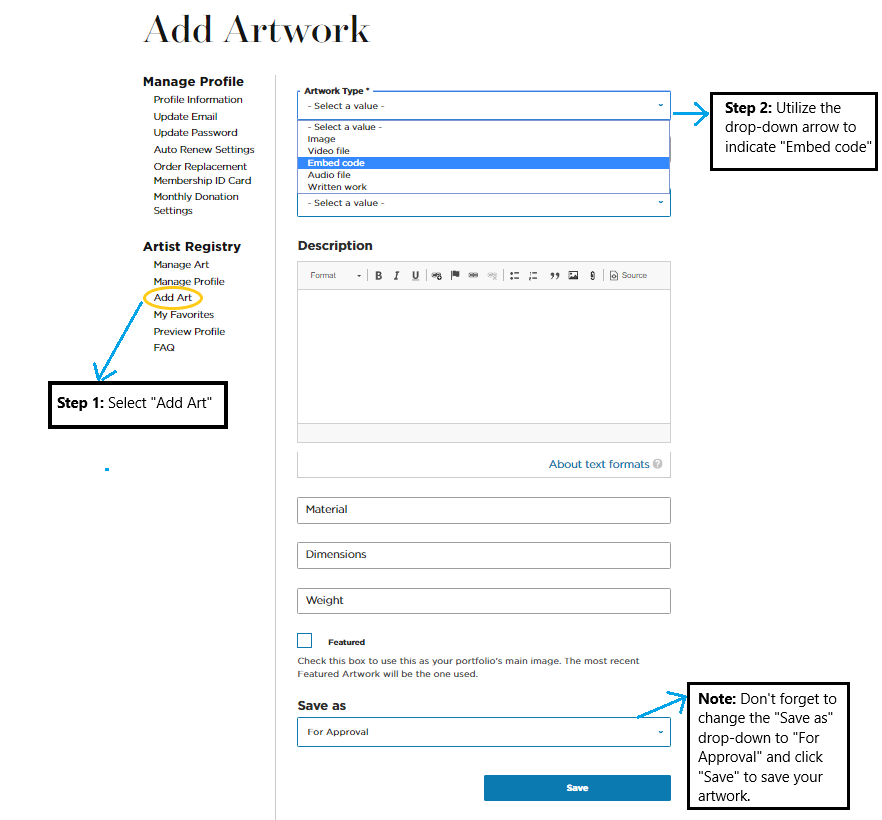
Unlike digital image, audio, and video contributions, poetry and creative writing files do not need to be uploaded onto the site. Instead, you can cut and paste work from a text document directly into the “Written Work” field. To do so, first click the “Add Artwork” tab on your artist control panel. Under “Artwork Type,” specify “Written Work” by clicking on the drop-down arrow. The selection will prompt you to then cut and paste your written work into the corresponding field from your text document. You may also indicate a title and write a description of the piece, if you wish.
Once you have logged in to your account, you will be taken to “My 9/11 Memorial,” your Artists Registry profile management page. The left-hand menu of this page will allow you to access your information, change your contact information and password, and manage your images, statement, and resume/bio text. Changes to contact information will take effect immediately. However, changes to images/audio/video files and statement/resume/bio content are subject to review by 9/11 Memorial Museum staff.
There are many ways to create images of your artwork as a digital file by using a digital camera, scanning older slides into electronic or digital images, or creating a CD of your artwork from 35 mm film. Many commercial digital and photographic services are equipped to scan your slides.
There are two ways to search the Artists Registry. You can either browse alphabetically by clicking on the first letter of your surname and scrolling through the alphabetized search results, or to access your profile more directly, you can click “Show Filters” on the right corner of the Registry homepage graphic and type your full name into the search bar; then click “Search” to the immediate right to initiate results.
As long as your larger artist collective or group-created project has a communal e-mail address, you may register your project. Only one e-mail address is permitted for a given portfolio in the Artists Registry. On your “My Profile” homepage, if you click on the “Account Information” tab listed on the left side of the screen, go directly to “Artist Registry Information” to indicate your “Artist Type.” Click the drop-down arrow and choose how you’d like to identify yourself; whether as an Individual Artist, Artist Collaboration, Gallery, Community Group, or School Group.
The image of the musical notes signifies that an artist has uploaded a song or musical composition to his/her profile page and wishes to feature this piece. The image of the “play” arrow signifies that an artist has uploaded a video file to his/her profile. The image of the feather pen signifies that the artist has uploaded a written work such as a poem, story, or essay and wishes to feature it in his/her profile. Artists designated by these symbols may also have other media on their profile pages, but they have chosen to feature art pieces of these media types.
Thank you for joining the Artists Registry at the National September 11 Memorial Museum (9/11 Memorial Museum). Whether you intend to use this site as a contributing artist (“Artist”) or as a researcher (“Researcher”), we ask that you please accept the terms of this agreement, which will be applied to all your future uses of the site. Once you accept this agreement, you will be able to customize your “Favorites” and contribute artwork (“Work”), if you choose to do so. A Researcher who contributes Work will be considered an Artist for purposes of this agreement.
This agreement may be updated from time to time at the sole discretion of the National September 11 Memorial & Museum (the “9/11 Memorial”).
The Artist represents and warrants that he/she owns the copyright and all other rights to his/her Work and agrees to grant the 9/11 Memorial a license to display his/her submitted Work within the Artists Registry database on the world wide web, within the physical Memorial Museum when it is open to the public, and in any educational publications produced by the Memorial Museum.
The Artists Registry at the National September 11 Memorial & Museum employs standard safeguards to protect Work submitted to the database and displayed on the web. The Artist hereby acknowledges and accepts that the 9/11 Memorial, its directors, employees, representatives, and agents shall not be liable to the Artist for any infringement or misappropriation by a third party of any intellectual property or similar rights (including any moral rights) that the Artist may have in the Work. The Artist further agrees to release, discharge, indemnify, and hold the 9/11 Memorial, its directors, employees, representatives, and agents harmless from any and all liabilities, losses, damages, and expenses arising out of any claim by a third party that the Work infringes or misappropriates such third party's intellectual property or similar rights (including any moral rights). Further, the Artist hereby releases the 9/11 Memorial from any claim for payment or any other compensation relating to the use of the Work.
Both the Artist and the Researcher agree to respect the copyrights of others and comply with all applicable licenses in their use of the Artists Registry. If you believe that your rights are being violated, please review our copyright policy and take-down notice procedure here.
The 9/11 Memorial is the sole arbiter of the content of its site, and thus retains the right to remove any Work from the site. 9/11 Memorial has no obligation (express or implied) to use (or post) the Work or, if commenced, to continue to use (or post) the Work and may at any time abandon the use (or posting) of the Work for any reason, with or without legal justification or excuse.
By clicking “I agree” below, the Artist or the Researcher, as applicable, acknowledges that he/she is of legal age and has read, fully understands, and agrees to be bound by the terms above.
If you reject the proposed terms above, you will not have an opportunity at this time to contribute Work (if you are an Artist) or to utilize the “Favorites” tool (if you are an Artist or a Researcher).
You acknowledge that use of the Artist’s Registry is also governed by the 9/11 Memorial site’s Term of Use.
Members who join online can reserve their free admission ticket(s) to visit the Museum as soon as a membership is purchased. Enter your Patron ID from your temporary card that is emailed to you. Members will receive their member package with the remaining benefits approximately 14 business days after purchase.
If you lose your membership card, please call the Membership Department at (212) 857-0154, or email membership@911memorial.org. There is a $5 replacement fee.
Additional guests may purchase tickets at the membership window and use the membership line if they are accompanied by a member. Only guests of “Benefactor Circle” members using complimentary anytime tickets may use the express member entry and ticket window without the member being present.
No. Guest pass vouchers may be used only if guests are accompanied by a member. However, we do offer anytime admission passes for “Benefactors Circle” members at the “Visionary” level and above. For anytime passes, a member need not be present during the time of visit. For more information about our “Benefactors Circle,” email us at benefactors@911memorial.org.
The World Trade Center (WTC) was a 16-acre commercial complex in lower Manhattan that contained seven buildings, a large plaza, and an underground shopping mall that connected six of the buildings. The centerpieces of the complex were the Twin Towers. On September 11, 2001, the entire complex was destroyed in a terrorist attack that has come to be referred to as “9/11.”
The Twin Towers were the tallest buildings in New York City. At 110 stories each, 1 WTC (North Tower) and 2 WTC (South Tower) provided nearly 10 million square feet of office space for about 35,000 people and 430 companies. For a brief period upon their completion in 1973, they were the tallest buildings in the world. They attracted roughly 70,000 commuters and tourists daily.
The towers were massive. The North Tower rose 1,368 feet—1,730 feet with a large antenna—and the South Tower stood 1,362 feet high. Views extended 45 miles or more from the top of the towers in every direction—far enough to see all five New York City boroughs, New Jersey, and Connecticut. Each weighed more than 250,000 tons and contained 99 elevators and 21,800 windows. Each floor was an acre in size and there was enough concrete in the towers to build a five-foot-wide sidewalk from New York City to Washington, D.C.
The towers had been the target of an attack before 9/11. On February 26, 1993, terrorists with links to an Islamist extremist group detonated explosives in a van parked underneath the WTC. Six people were killed and thousands were injured.
“9/11” is shorthand for four coordinated terrorist attacks carried out by al-Qaeda, an Islamist extremist group, that occurred on the morning of September 11, 2001.
Nineteen terrorists from al-Qaeda hijacked four commercial airplanes, deliberately crashing two of the planes into the upper floors of the North and South Towers of the World Trade Center complex and a third plane into the Pentagon in Arlington, Virginia. The Twin Towers ultimately collapsed because of the damage sustained from the impacts and the resulting fires. After learning about the other attacks, passengers on the fourth hijacked plane, Flight 93, fought back, and the plane was crashed into an empty field in western Pennsylvania about 20 minutes by air from Washington, D.C.
The attacks killed 2,977 people from 90 nations: 2,753 people were killed in New York; 184 people were killed at the Pentagon; and 40 people were killed on Flight 93.
The hijacked Flight 11 was crashed into floors 93 to 99 of the North Tower (1 WTC) at 8:46 a.m. The hijacked Flight 175 struck floors 77 to 85 of the South Tower (2 WTC) 17 minutes later at 9:03 a.m. When the towers were struck, between 16,400 and 18,000 people were in the WTC complex. Of those, the vast majority evacuated safely. As they rushed out, first responders rushed in trying to save those still trapped or injured.
The fires from the impacts were intensified by the planes’ burning jet fuel. They weakened the steel support trusses, which attached each of the floors to the buildings’ exterior walls. Along with the initial damage to the buildings’ structural columns, this ultimately caused both towers to collapse. The five other buildings in the WTC complex were also destroyed because of damage sustained when the Twin Towers fell.
The collapse of the buildings left the site devastated. Thousands of volunteers came to Ground Zero to help with the rescue, recovery, and clean-up efforts, and on May 30, 2002, the last piece of WTC steel was ceremonially removed.
Al-Qaeda is an international Islamist extremist terrorist network founded in the late 1980s by Osama bin Laden, who was killed in a U.S. military operation on May 1, 2011, and others who were involved in the war against the Soviet Union in Afghanistan. Their aim has been to overthrow governments in the Middle East, and elsewhere in the Muslim world, which do not strictly enforce a religiously sanctioned political and social order. Attacks against the United States were intended to reduce American support for many of these governments; U.S. support was viewed by al-Qaeda as a major obstacle to creating a global order under Islamic authority.
They have claimed responsibility for numerous terrorist attacks since the early 1990s, including the 1998 U.S. Embassy bombings in Kenya and Tanzania, the 2000 attack on the USS Cole, and the 9/11 attacks. They have also aligned themselves with and inspired other terrorist groups who have carried out attacks, including the 2002 Bali bombing, the 2004 Madrid train bombing, the 2005 London bombings, and the 2008 Mumbai terrorist attacks, among many others.
“Islamists” see Islam as a guiding ideology for politics and the organization of society. That is, they believe that strict adherence to religious law should be the sole basis for a country’s law, as well as its cultural and social life. While some Muslims believe this, many do not. Islamist extremists believe violence is acceptable to achieve these ends. Al-Qaeda is one of many Islamist extremist groups.
The terrorists did not have the capacity to destroy the United States militarily, so they set their sights on symbolic targets instead. The Twin Towers, as the centerpieces of the World Trade Center, symbolized globalization and America’s economic power and prosperity.
The Pentagon, as the headquarters for the U.S. Department of Defense, serves as a symbol of American military power. It is thought that Flight 93 was headed to the Capitol building, the center of American legislative government.
Al-Qaeda hoped that, by attacking these symbols of American power, they would promote widespread fear throughout the country and severely weaken the United States’ standing in the world community, ultimately supporting their political and religious goals in the Middle East and Muslim world.
Al-Qaeda was based in Afghanistan. They operated training camps there, and openly lived in the country with the support of the Taliban, an Islamist group that ruled the country.
On September 20, 2001, in a speech to a joint session of Congress, former President George W. Bush asserted: “Any nation that continues to harbor or support terrorism will be regarded by the United States as a hostile regime.” No distinction was made between a harboring state and the terrorists it was harboring. The U.S. government insisted that the Taliban immediately hand over the terrorists and close the training camps or face an attack from the United States. When they refused, “Operation Enduring Freedom” was launched on October 7, 2001, less than a month after the attacks of 9/11.
In the aftermath of 9/11, tens of thousands of men and women from across the nation and around the world came to the site, which had become known as Ground Zero, to help.
These rescue and recovery workers worked day and night for nearly nine months to rescue those who had been trapped alive, recover the remains of victims, and to clear the site of 1.8 million tons of debris. These efforts took nearly nine months, officially ending on May 30, 2002. Many individuals who worked in these efforts have become sick due to their exposure to toxic air at the site. Thousands have since died from these illnesses.
When the Twin Towers collapsed, lower Manhattan and the surrounding area was covered by an enormous cloud of dust. This dust lingered in the air for many months after 9/11. Analysis of the air found concrete, insulation, jet fuel, electrical and computer equipment, glass particles, and plastics that had been pulverized. This air was unsafe to breathe.
It’s estimated that more than 400,000 people were exposed to this air. This includes those who worked at Ground Zero, survivors, and those who lived and went to school nearby. Over time, many would be diagnosed with respiratory issues and chronic illnesses. Today more than 80,000 people are known to be suffering from 9/11-related illnesses including lung diseases, mental health issues, and over 50 types of cancer. Thousands have died and these numbers continue to rise.
On May 30, 2019, the Memorial Glade was dedicated on the 9/11 Memorial Plaza. The Glade honors all who are suffering or have died because of exposure to hazards and toxins at the World Trade Center Site in the aftermath of 9/11.
Make a donation to the Museum