Alice Greenwald is Named President and CEO of 9/11 Memorial & Museum

Alice Greenwald is Named President and CEO of 9/11 Memorial & Museum

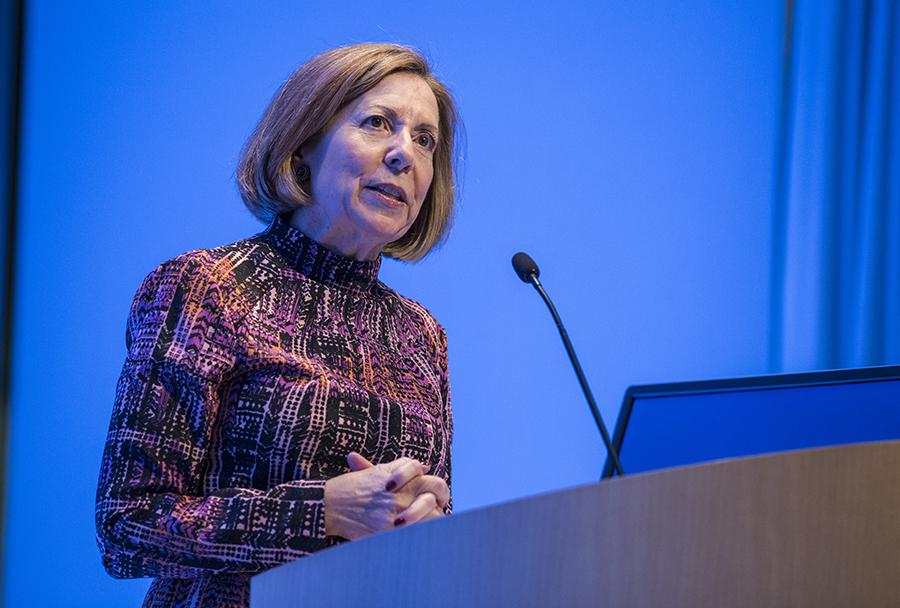
9/11 Memorial & Museum President Alice Greenwald speaks at a podium during a program in the Museum Auditorium.
9/11 Memorial Museum Director Alice Greenwald has also been named president and CEO. She’s seen her speaking at recent program at museum.

The National September 11 Memorial & Museum’s board of directors today voted to name Alice Greenwald as president and CEO. As director of the museum since 2006, Greenwald has spent the past decade envisioning and helping build the museum experience to commemorate and honor the victims and survivors of the 9/11 attacks and the Feb. 26, 1993 bombing of the World Trade Center.

She will continue her functions as museum director in her new role, which begins Jan. 1. She succeeds outgoing president and CEO Joe Daniels.

“Alice has been instrumental to every detail in the design, inspiration, and operation of the museum, and she is uniquely qualified to sustain the memorial and museum’s profound role in telling the story of 9/11,” said Michael R. Bloomberg, chairman of the 9/11 Memorial & Museum. “I join the entire board in congratulating Alice and lending her our full support as she builds on Joe Daniels’ exceptional work. I am confident the institution will flourish under Alice’s capable stewardship.”

During her tenure as director, Greenwald and her team led the creation of the 9/11 Memorial Museum experience. She planned and developed the museum’s exhibitions, facilitated its 2014 opening, and launched programs that reach millions of people around the world. Under her leadership, a record 7.4 million visitors have come to the museum. In just the past year, the Museum welcomed Pope Francis and unveiled its first major special exhibition, “Rendering the Unthinkable: Artists Respond to 9/11.”

“I’m deeply humbled to have been selected by the Board to succeed Joe Daniels as the next President of the 9/11 Memorial and Museum,” Alice Greenwald said. “In today’s world, the need to help New Yorkers and Americans reckon with the tragedy of such immense loss has only grown. Even as the September, 11, 2001 attacks recede further into memory, the nearly 30 million people who have visited the Memorial in recent years are a testament to its enduring importance. I’m honored to have been chosen to be the keeper of that mission.”

By 9/11 Memorial Staff

The Lens: Capturing Life and Events at the 9/11 Memorial and Museum

The Lens: Capturing Life and Events at the 9/11 Memorial and Museum

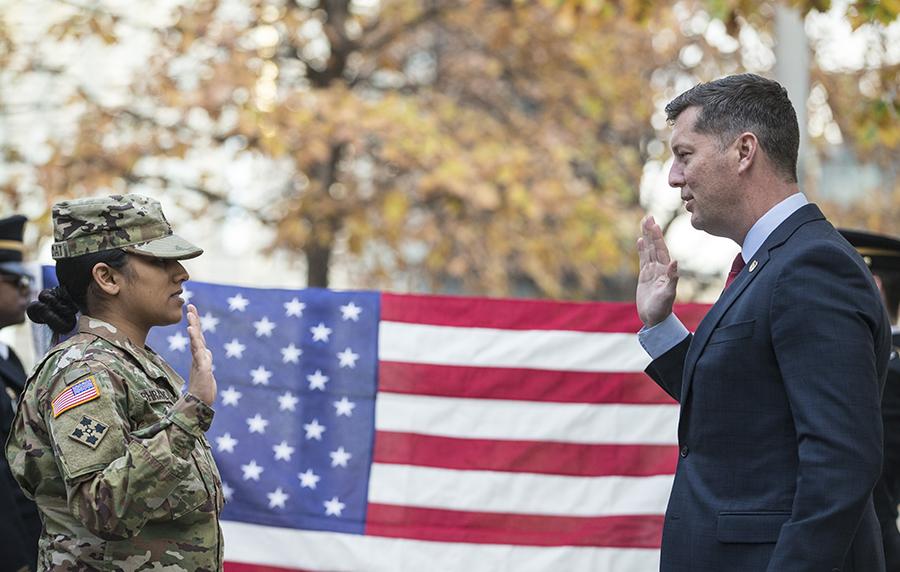
Under Secretary of the Army Patrick Murphy officiates a promotion ceremony on the 9/11 Memorial. He is holding up his right hand as he stands across from a woman in a U.S. military outfit who is also holding up her right hand. An American flag is hanging in the background.
Under Secretary of the Army Patrick Murphy officiates a promotion ceremony on the 9/11 Memorial. Photo by Jin Lee.

The Lens: Capturing Life and Events at the 9/11 Memorial and Museum is a photography series devoted to documenting moments big and small that unfold at the 9/11 Memorial and Museum.

The View: The 9/11 Memorial & Museum hosted special events and programs for veterans and their families last week during an annual five-day Salute to Service. This year the tribute included a military reenlistment and promotion ceremony on the 9/11 Memorial officiated by Under Secretary of the Army Patrick Murphy.

Salute to Service also included a visit by the grand marshals of the 2016 Veterans Day Parade, all three veterans and 9/11 first responders, who laid a wreath at the Survivor Tree, and a performance by the U.S. Navy Academy Women’s Glee Club.

In remembrance of 9/11 first responders and veterans, American flags were placed on the Memorial. Yellow roses were placed on the Memorial on Veterans Day.

By 9/11 Memorial Staff

9/11 Memorial: A Tribute to the Past and Hope for the Future

9/11 Memorial: A Tribute to the Past and Hope for the Future

COM PLAZA GEN_19159_Cropped.jpg
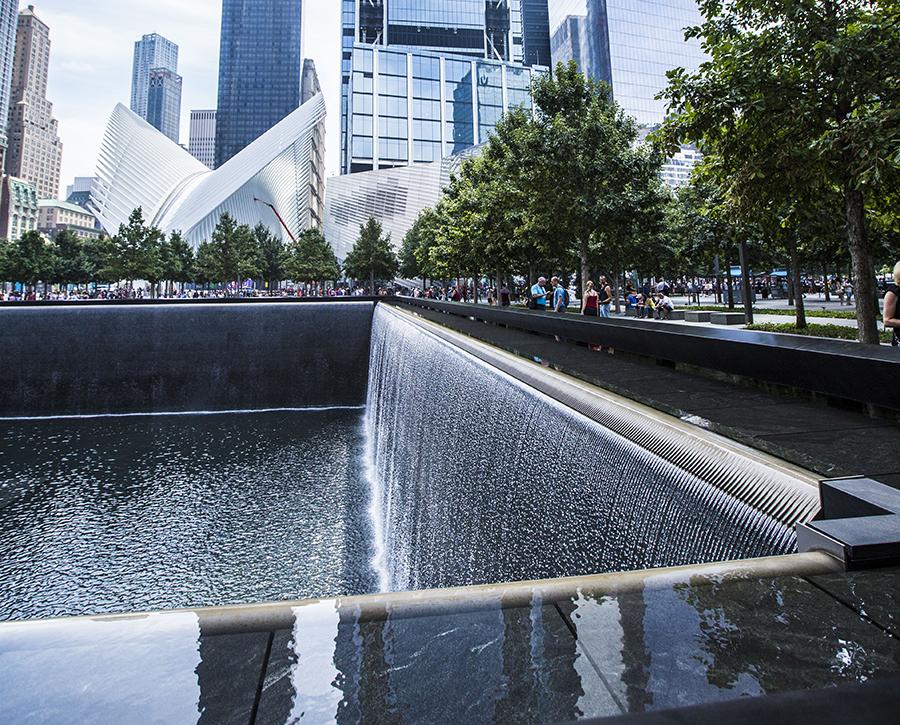
A view of the north pool on the 9/11 Memorial plaza. Photo by Jin Lee.

Set within the footprints of the Twin Towers, the 9/11 Memorial reflecting pools are each nearly an acre in size and feature the largest man-made waterfalls in North America. The large voids are visible reminders of the loss and absence felt by New Yorkers and around the world. On the 9/11 Memorial plaza, there are over 400 swamp white oak trees which were selected because of their durability and unique leaf colors. The canopy of trees along with the sound of cascading water creates a reflective space, separate from the bustling sounds of New York City.

By 9/11 Memorial Staff


9/11 Memorial Architect Joins Panel Discussing the Kinship Between Memory and Architecture

9/11 Memorial Architect Joins Panel Discussing the Kinship Between Memory and Architecture

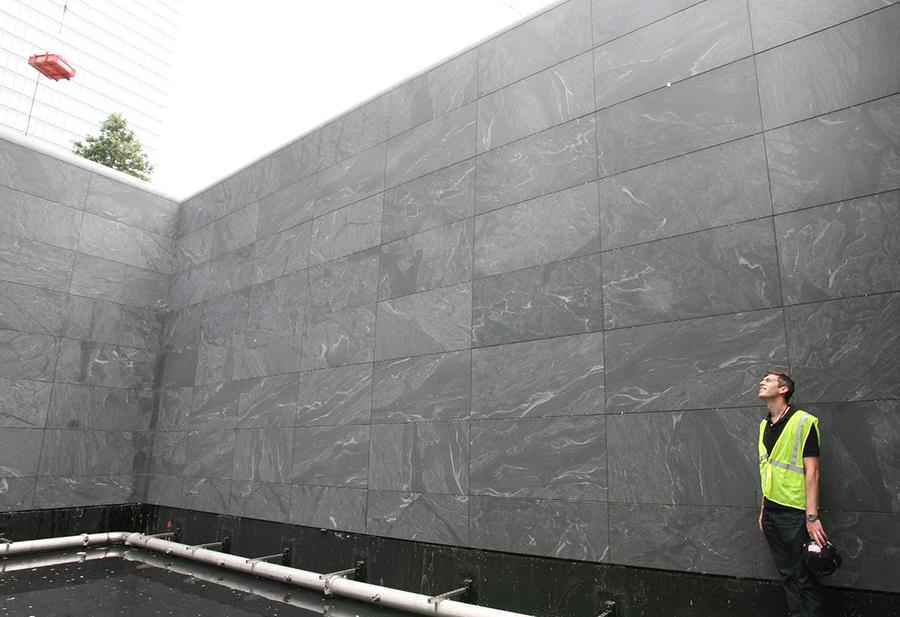
Architect Michael Arab stands inside one of the reflecting pools before the 9/11 Memorial was completed.
Architect Michael Arad stands inside one of the reflecting pools in June 2011 before the 9/11 Memorial was completed. Photo by Amy Dreher.

Tomorrow evening, the architect of the 9/11 Memorial, Michael Arad, joins a panel to discuss the relationship between architecture and remembrance. Arad will be joined by the architects of the Pentagon and Shanksville, Pa., memorials, respectively Paul Murdoch and Julie Beckman. The talk, titled “The Architecture of Remembrance,” is part of the fall programming schedule at the 9/11 Memorial Museum. It is also a feature program of Archtober, a month-long festival of architecture activities, programs and more held this month. To attend the free program tomorrow, please RSVP.

In Feb. 8, 2010, Arad sat down for an oral history and talked about what led him to formulate his design for a 9/11 memorial he called “Reflecting Absence” before there was an official design competition. Here is an excerpt from that recording given by 9/11 Memorial Museum oral historian Amy Weinstein.

Arad: I had this idea for a memorial that kept eating away at me and I just had to explore it further. For some reason I thought about a memorial actually out in the Hudson River. . . I had this idea of these two voids that would be carved or cut or break the surface of the river, and water would spill into them and these voids would never fill up. This sense of something being torn apart and not mending. That despite all this water that flows into these voids they would never disappear and that sense of absence that I felt was persistent and made visibly persistent.

I ended up figuring out a way to design this fountain that I imagined out in the Hudson River. I thought it is one thing to imagine it and sketch it and draw it, I really had to build a little model to see what it would look like in physical form…

I remember the very first moment when we sort of plugged it in and filled it up and all of a sudden I could see that image of the surface of the water broken by those two voids. It was a very gratifying and exciting moment for me. But I set it aside. Actually, I took it home, brought it back up to my rooftop. Took a few pictures of it with the skyline of the city beyond, reflected on the surface of the fountain and these voids in the surface of the fountain. It was very much as I imagined the view might be from New Jersey looking across toward New York, with these voids in the river and the skyline beyond, and the absence in the skyline being made manifest in some way in the surface of the river.

I had this model and I had those pictures and I really didn’t know what to do with it. I set it aside and came back to it maybe a year later, or a few months later, when the competition for the actual memorial site was announced.

By 9/11 Memorial Staff

A Look Back at Manhattan’s Radio Row

A Look Back at Manhattan’s Radio Row

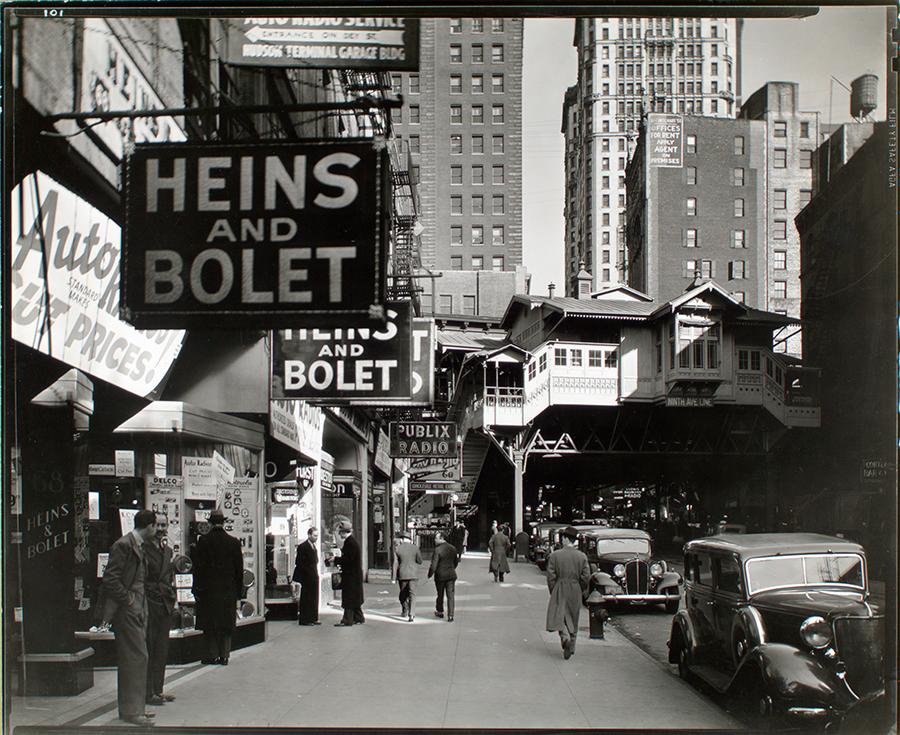
A view shows “Radio Row” in Manhattan in 1936. Signs line storefronts. An elevated subway station is seen in the background.
A view of “Radio Row” in 1936. Photo by Berenice Abbott, courtesy of the New York Public Library Collection.

Decades before the World Trade Center was built, the lower Manhattan neighborhood once known as Radio Row bustled with commercial activity. As recounted by Tribeca Tribune, it was home to restaurants, flower shops, hardware stores and bookstores, as well as the roughly 400 radio, television and hi-fi stores that inspired the district’s name.

As the radio industry grew throughout the 1920s, ham radio hobbyists and other customers flocked to the area from hundreds of miles away in search of hard-to-find items. By the 1950s, the assorted mom-and-pop stores comprised a multi-million dollar national and international electronics market.

The merchants supported the initial proposal for an international trade center, as its location along the East River near the current South Street Seaport promised to bring more business to Radio Row. But when plans for the World Trade Center were moved to the west, Radio Row faced destruction. Despite protests and planned legal action, the merchants were unable to defend their domain.

The Port Authority offered each affected business $3,000 to relocate. Some moved, but most went out of business. By 1966 nearly all had closed their doors in anticipation of the twin towers.

By 9/11 Memorial Staff

Family Leaves Reese's Cups on 9/11 Memorial in Tribute to Ronald Fazio

Family Leaves Reese's Cups on 9/11 Memorial in Tribute to Ronald Fazio

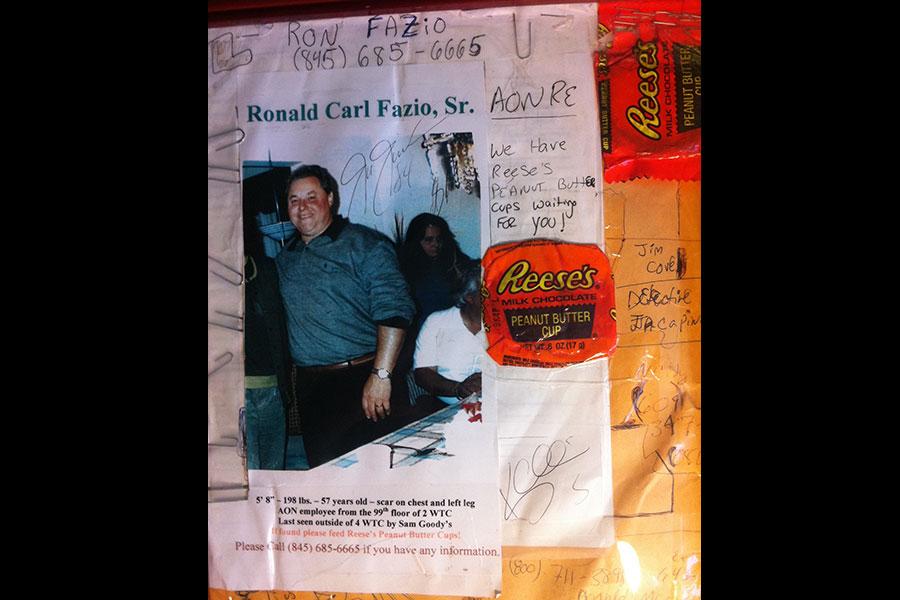
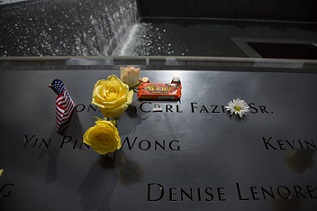
A missing poster for Ronald Fazio includes Reese’s peaut butter cups, his favorite candy.
Missing poster with Reese's tribute for Ronald Carl Fazio, Sr. Gift of Rob Fazio.

First, there were sightings of Peanut Butter Cup wrappings tacked to the walls of the Family Room. Then, those same distinctive Reese's treats were spotted along the South Pool of the 9/11 Memorial. Unlike more recurrent offerings of fresh flowers, folded notes, miniature flags and small, weather-resistant tokens like coins, these candy tributes have added an element of intrigue. 

Clues to their meaning presumably resided in the names etched into the South Pool Panel S-60, where the chocolate snack materialized once again during the ceremony for the 15th anniversary of 9/11. Sure enough, a group of family members was seen congregating here, each wearing a Reese’s Peanut Butter Cup T-shirt, each giving the name of victim Ronald C. Fazio, Sr. an affectionate touch. 

In the 9/11 Memorial Museum’s memorial exhibition, a short biography introduces Fazio as a 57-year-old Aon Corporation accountant whose office was on the 99th floor of the South Tower. On that fateful Tuesday, he is credited with saving lives by urging his coworkers to evacuate when he saw the North Tower in flames. He hastened their exit by holding the door open for them, delaying his own descent. Fazio’s selfless legacy is perpetuated today in the Hold the Door For Others Foundation, founded by his family.Reese's tribute for Robert Fazio at the 9/11 Memorial. Photo by Amy Dreher.
A big-hearted man, he is also remembered as the devoted father of three grown children and as an enthusiast of the New Jersey’s beaches. He loved to cook up the catch of the day from his exploits as a crabber. The Museum’s collection includes a handful of beach glass and a lucky crabbing line donated in his memory by his wife, Janet.        

But an important continuity thread has been omitted from this portrait: Fazio’s penchant for Reese’s Peanut Butter Cups. Apparently his taste for them was as defining as the physical characteristics of height, weight and scar locations reported on the missing person flyers his family rushed to distribute on 9/11.  Indeed, Fazio’s adult children felt compelled to ornament some with stapled cut-outs from the candy packages and include this appeal on them: “If found, please feed Reese’s Peanut Butter Cups.” The addition interjected a twinkle of levity to the urgent, ultimately elusive mission of the posters.

A year after 9/11, Fazio’s family buried a coffin near their New Jersey home empty of his remains, but filled with sweet keepsakes, including some Reese's cups. In conversing with Fazio’s son Rob last month at Panel S-60, we learned that Ronald Fazio’s sweet tooth lives on.  His baby granddaughter, born years after his death, is named Reese Fazio. She was wearing a tiny branded T-shirt matching those of her parents on Sept. 11, 2016.

By Jan S. Ramirez, 9/11 Memorial Chief Curator 
White Rose Signifies Remembrance of 9/11 Victims' Birthdays

White Rose Signifies Remembrance of 9/11 Victims' Birthdays

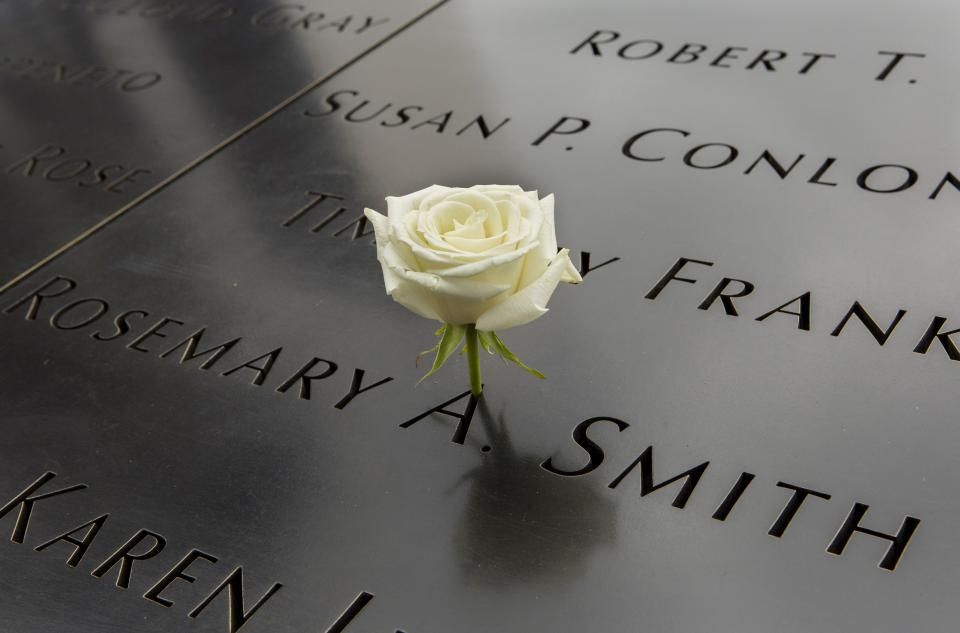
A white rose stands at the name of Rosemary Smith on the 9/11 Memorial.
A white rose is left on the name of Rosemary A. Smith.

An idea from a volunteer in 2013 has become another way for visitors to learn about the victims, share their experience and connect. Before opening to the public, 9/11 Memorial Museum staff places a white rose at the name of each victim who has a birthday that day.

Inscribed on the 9/11 Memorial are the names of the 2,983 victims of the 1993 and 2001 attacks. Every morning a staff member checks a binder located in the 9/11 Memorial Museum that has each name and birthday listed chronologically. A white rose is cut two inches below the leaves and then placed at the name on the parapet.

Museum volunteer and 9/11 survivor, George Mironis requests this responsibility on the days he works. He even comes in on days he’s scheduled to be off to place the roses. For him, it’s a way to honor the friends and co-workers he lost 15 years ago.

There is at least one birthday for every day of the year and often more than one a day. Mikey “Flowers” Collarone of FloraTech, a downtown florist and former emergency medical technician that responded to 9/11, hand selects the roses from a local flower market and donates them to the 9/11 Memorial Museum.

By 9/11 Memorial Staff

Katie Couric Interview Concludes First Season of Our City. Our Story. Podcast

Katie Couric Interview Concludes First Season of Our City. Our Story. Podcast

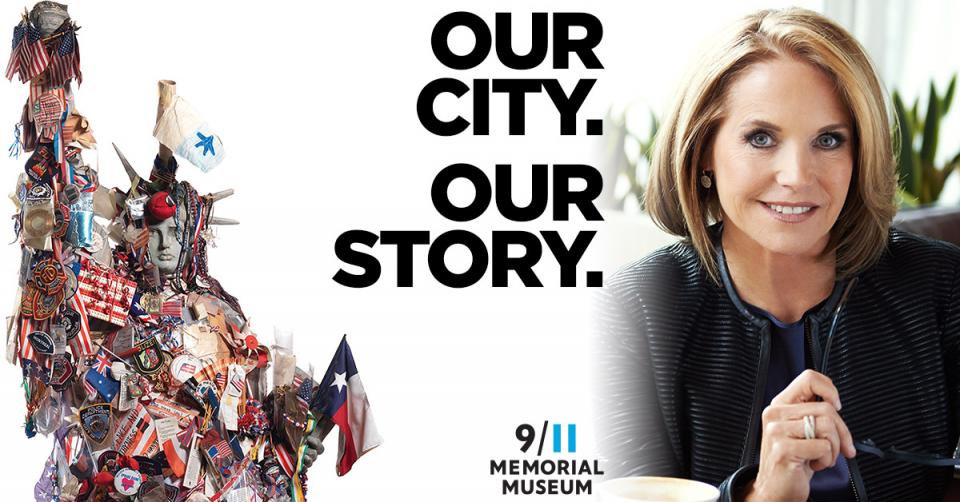
Katie Couric smiles as she poses for a photo.
Katie Couric in the Our City. Our Story. podcast series.

Millions remember watching “The Today Show” on the morning of 9/11 and looking to Katie Couric and her co-host Matt Lauer to explain the unfolding attacks on the country. Fifteen years later, Couric sat down with Our City. Our Story. podcast host Jenny Pachucki to revisit her memories of that morning and reflect on how the city has recovered.

In this episode, "The Couric Effect," named after the influence that Couric has had on colon cancer screening, the Yahoo Global News Anchor remembers the responsibility she felt to her audience and the collective grief that the city felt in the aftermath.

"I remember the most emotionally searing time was, for me, were those days following 9/11 with all the signs and the Xeroxed pictures that were affixed on the chain-link fences. Where there was so much desperation to find people," said Couric.

This episode is the final in the first season of the Our City. Our Story. podcast series. Other New Yorkers who are featured include Robert De Niro, Imam Khalid Latif, and George Whipple. Together, these New York stories reveal a link of resilience and commitment to the city. The series will return with a second season in early 2017.

By 9/11 Memorial Staff

Athletes Trek 75 Miles to 9/11 Memorial, Raise Money for Children of 9/11 Victims

Athletes Trek 75 Miles to 9/11 Memorial, Raise Money for Children of 9/11 Victims

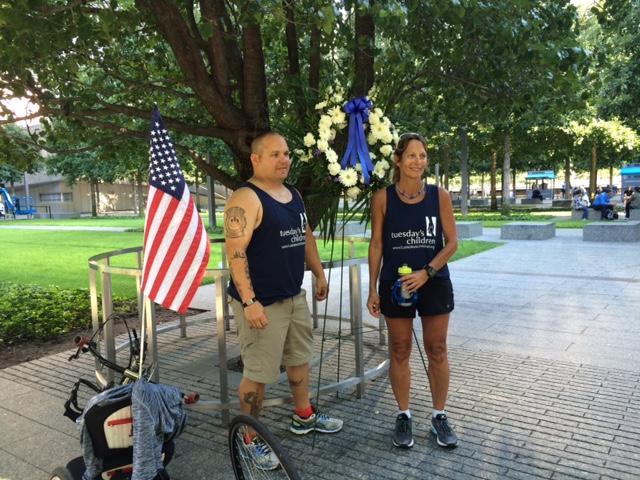
Eva Casale and Michael Roesch pose beside the Survivor Tree at the 9/11 Memorial.
Eva Casale and Michael Roesch on the 9/11 Memorial plaza. Photo courtesy of Tuesday’s Children.

Two New York athletes battled the late summer heat to participate in a 75-mile expedition to raise money for the children of 9/11 victims.

Long-distance runner Eva Casale and former Air Force veteran Michael Roesch traveled from Manhasset, NY to the 9/11 Memorial on Sunday, laying wreaths at memorials in Long island, Brooklyn and Staten Island along the way.

The 75-mile trek, dubbed the “Footsteps for 15,” took place to honor the memory of the victims of Sept. 11 and to raise funds for Tuesday’s Children. The athletes raised $4,000 for the charity which “supports youth, families, and communities impacted by terrorism and traumatic loss,” according to their website.

Casale ran the 75-mile course to downtown Manhattan while her counterpart, Roesch, rode a hand-pedaled bicycle.

“The first responders — firefighters and (the) police department and EMTs — were the first ones in the war against terrorism, and for me it’s important not to forget that,” Roesch told the New York Daily News.

“Just seeing all those that were lost and keeping that in our hearts was keeping us going,” Casale told the Daily News.

By 9/11 Memorial Staff

New Our City. Our Story. Podcast: A Changing Brooklyn

New Our City. Our Story. Podcast: A Changing Brooklyn

Harold Buisson poses for a photo in a suit and tie.
Harold Buisson in the Our City. Our Story. podcast series.

Born and raised in Flatbush, Brooklyn, Harold Buisson has seen the borough transform dramatically since 9/11. In the latest Our City. Our Story. podcast episode, he notes how the physical landscape of his neighborhood and New York City has changed over the last few years.

“In my old neighborhood, when I saw that they started installing additional fire hydrants and more trees, that gave me the signal, ‘Oh, they actually care if this building burns down now and they’re beautifying the area,’” Buisson said.

On the morning of Sept. 11, Buisson was heading to a meeting at his office, located near the World Trade Center. He ran for his life as the debris from the collapsing South Tower threatened to overtake him. Buisson eventually found himself standing in the middle of a crowded street with other onlookers. They watched in utter disbelief as the second tower fell.

“I remember looking at the remaining building, which had the big antenna. And right when I’m sitting there you hear a rumble and you see it going down, like slow. And I was like, ‘Oh, wow.’ And then it got silent for a minute. And then people start panicking again. You could smell all the smoke and burning all the way up there.”

Listen to more of Buisson’s experience on 9/11 and how he feels the city has changed since the terror attacks here. The series is also available on iTunes.

By 9/11 Memorial Staff

Subscribe to 9/11 Museum